A Parent’s Guide to Pediatric Cardiac Arrest Management

Updated on: December 26, 2025
Sudden Cardiac Arrest (SCA) impacts thousands of children yearly. Critically, most pediatric SCA begins with respiratory failure or shock. Therefore, giving quick, effective breaths (oxygen) is extremely important for a child’s survival. Pediatric cardiac arrest management demands specialized care and fast action. Even a brief pause can result in devastating brain damage.
Only 15.9% of children (aged 1-18) treated for Out-of-Hospital Cardiac Arrest (OHCA) in 2023 survived to hospital discharge, according to the Sudden Cardiac Arrest Foundation. Therefore, knowing the correct steps for managing pediatric cardiac arrest truly makes a difference between life and death. This guide will simply break down the essential, immediate steps you must take.
What is Pediatric Cardiac Arrest?
Pediatric cardiac arrest means a child’s heart hasstopped pumping blood, leaving the child unresponsive with abnormal breathing Here is the basic difference between a cardiac arrest in adults versus children:
- Adults: Cardiac arrest usually results from a sudden electrical malfunction in the heart (ventricular fibrillation, often following a severe heart event).
- Children: Cardiac arrest usually stems from respiratory failure or severe shock, leading to a lack of oxygen (hypoxia). This can happen from choking, severe asthma, drowning, or a very bad infection that causes respiratory failure.
If you see a child collapse, is unresponsive, and isn’t breathing or is only gasping, you must start acting right away.
Read More: How to Overcome Challenges During Pediatric Emergencies?
Pediatric Cardiac Arrest Management: Step-by-Step Process
Performing the correct sequence of steps is the key to restoring life. This involves moving from Basic Life Support (BLS) to Advanced Life Support (ALS). Below is the breakdown of the essential pediatric cardiac arrest management steps:
Step 1: Check, Call, and Send for Help
Your first actions set the stage for all pediatric cardiac arrest management.
Check the Condition
- Safety First: Make sure the area around the child is safe. Don’t put yourself in danger.
- Check Responsiveness: Gently tap the child’s shoulder and shout, “Are you okay?” For an infant, gently tap their foot. Do not shake a baby.
- Check Breathing: Quickly look, listen, and feel for breathing. Do not spend more than 10 seconds on this. If the child is not breathing or is only gasping, they need help. Don’t check for a pulse unless you are trained to do so.
Call for Help (Activate the Emergency System)
- If you did NOT witness the collapse (Single Rescuer): Shout for help. If no one comes, you need to provide 2 minutes of CPR first before leaving the child to call emergency services. (This is different from adult CPR, where you call first.)
- If you DID witness the collapse (Single Rescuer): Call emergency services (like 911) immediately and find an AED. Then, begin CPR.
If you have a cell phone, call immediately and put it on speaker.
- If someone is with you (Two Rescuers): Immediately tell them to call emergency services (like 911 or your local number) and find an AED (Automated External Defibrillator). Be specific: “You, in the blue shirt, call 911 now and ask for an AED!”
Step 2: Start High-Quality CPR
High-quality CPR is the most important part of pediatric cardiac arrest management. It pumps blood and oxygen to the brain and vital organs.
Airway and Breathing (The Oxygen Factor)
Since most pediatric cardiac arrest starts with a breathing issue, oxygen is vital.
- Open the Airway: Gently tilt the head back and lift the chin (the head-tilt/chin-lift). Be very gentle with infants; only tilt the head slightly.
- Give Two Breaths:
- Child: Pinch the nose shut and cover their mouth with yours, making a seal. Give one breath over one second and watch the chest rise. If it rises, give the second breath.
- Infant: Cover both the nose and mouth with your mouth to create a seal. Use gentle “puffs” of air (from your cheeks, not deep lung breaths) for one second each.
- Ratio: You will give 2 breaths after every 30 compressions (1 rescuer), or 2 breaths after every 15 compressions (2 rescuers).
Chest Compressions (C is for Circulation)
You need to push hard and fast in the center of the chest. The rate is the same for everyone: 100 to 120 compressions per minute. Here’s the complete overview:
| Age Group |
Hand Technique |
Compression Depth |
| Infant (under 1 year) |
Two fingers (or two thumbs encircling the chest if two rescuers) |
About 1.5 inches (4 cm) |
| Child (1 year to puberty) |
Heel of one hand |
About 2 inches (5 cm) or one-third the depth of the chest |
- Location: For all ages, compress the lower half of the breastbone (sternum).
- Recoil: Let the chest come fully back up after each push. This allows the heart to refill with blood. Do not lean on the chest.
- The Cycle: Do 30 compressions, then stop briefly to give 2 rescue breaths. This is one cycle. Continue until an AED arrives or help takes over.
Step 3: Use an AED (If Available)
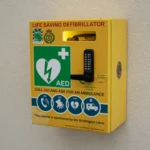
An Automated External Defibrillator (AED) is a machine that analyzes the heart’s rhythm and delivers an electric shock if needed. Getting an AED is a crucial step in advanced pediatric cardiac arrest management.
When the AED Arrives
- Turn it ON: Follow the voice prompts immediately.
- Attach Pads:
- Use pediatric pads if available for children under 8 years old. These reduce the shock dose. If pediatric pads are unavailable, use adult pads. If the adult pads are too large and risk touching each other on the child’s chest, use a front-back placement instead of side-by-side.
- Placement: Typically, one pad goes on the front center of the chest and the other goes on the back, between the shoulder blades (antero-posterior placement). Follow the pictures on the pads/AED!
- Analyze: The AED will tell everyone, “Analyzing heart rhythm. Do not touch the patient.” Listen and obey.
- Shock or No Shock:
- Shock Advised: Say “CLEAR!” out loud. Make sure no one is touching the child. Push the shock button when prompted.
- No Shock Advised: Continue CPR immediately.
- Resume CPR: After any shock (or if no shock was advised), start CPR right away, beginning with chest compressions. Continue CPR for two minutes until the AED prompts you to check the rhythm again.
Step 4: Specialized Pediatric Cardiac Arrest Management (The 4 H’s and 4 T’s)
In a hospital setting, or once paramedics arrive, the team moves to Advanced Life Support (ALS). While the CPR steps remain the same, the focus shifts to finding and fixing the cause of the pediatric cardiac arrest.
Healthcare providers look for reversible causes, often called the 4 H’s and 4 T’s:
-
4 H’s (The Main Causes):
-
Hypoxia (Not enough oxygen, the most common cause in children)
-
Hypovolemia (Not enough blood/fluid, like from severe bleeding)
-
Hypothermia (Being too cold)
-
Hyper-/Hypokalemia & Metabolic issues (Problems with salts or sugar in the blood)
-
4 T’s (Other Serious Causes):
-
Tension Pneumothorax (Air is squeezing the lung/heart)
-
Tamponade (Fluid around the heart, stopping it from filling)
-
Toxins (Poisoning or drug overdose)
-
Thrombosis (Blood clot, less common in kids, but possible)
Addressing these underlying problems is crucial to successful pediatric cardiac arrest management and achieving Return of Spontaneous Circulation (ROSC), where the heart resumes effective beating.
Read More: Benefits of Getting PALS Certified
Securing the Future: Your Role in Lifesaving Management
For a child in crisis, preparation dictates survival. Your PALS knowledge is the most powerful, life-saving tool while dealing with pediatric emergencies. You now understand that pediatric cardiac arrest is fundamentally an oxygen problem. You know the unique compression ratios (15:2 for two rescuers!) and the critical importance of early ventilation and defibrillation. The successful execution of pediatric cardiac arrest management relies on well-trained individuals ready to act. You can build that muscle memory.
Don’t just read about saving a life, get ready to do it. Sign up for a Pediatric Advanced Life Support (PALS) course today. Your fast, informed action is the final link in the chain that saves a child’s future.
FAQs
1. How should cardiac arrest in children be managed?
The first step is high-quality chest compressions. Push hard and fast on the center of the chest. Maintain a rate of 100 to 120 compressions per minute. The depth should be about one-third the depth of the chest (roughly 2 inches). Limit interruptions to compressions to less than 10 seconds each.
2. Which medication causes cardiac arrest in children?
Epinephrine remains the primary medication used during pediatric resuscitation. Getting the drug into the system via vascular access, especially through an intraosseous (IO) line, is preferred over delivery through the breathing tube (endotracheal).
3. What is the pediatric CPR protocol?
Position yourself over the child’s chest. Place the heel of one hand in the center of the chest, and the heel of your second hand on top (or use one hand for smaller children). Lock your elbows and keep your arms straight. Give 30 compressions at a rate of 100 to 120 per minute, pushing about two inches deep. Follow the compressions immediately with two breaths.
PALS CERTIFICATION
Author
PALS Certification is a trusted provider of online life support training, offering PALS, BLS, and ACLS certification and renewal courses. Our flexible training programs follow industry guidelines, offer self-paced learning and instant certification, ensuring providers stay compliant, advance their credentials, and deliver high-quality patient care.